
Chile stands out at the London Design Biennale with a pavilion exploring mineral wisdom
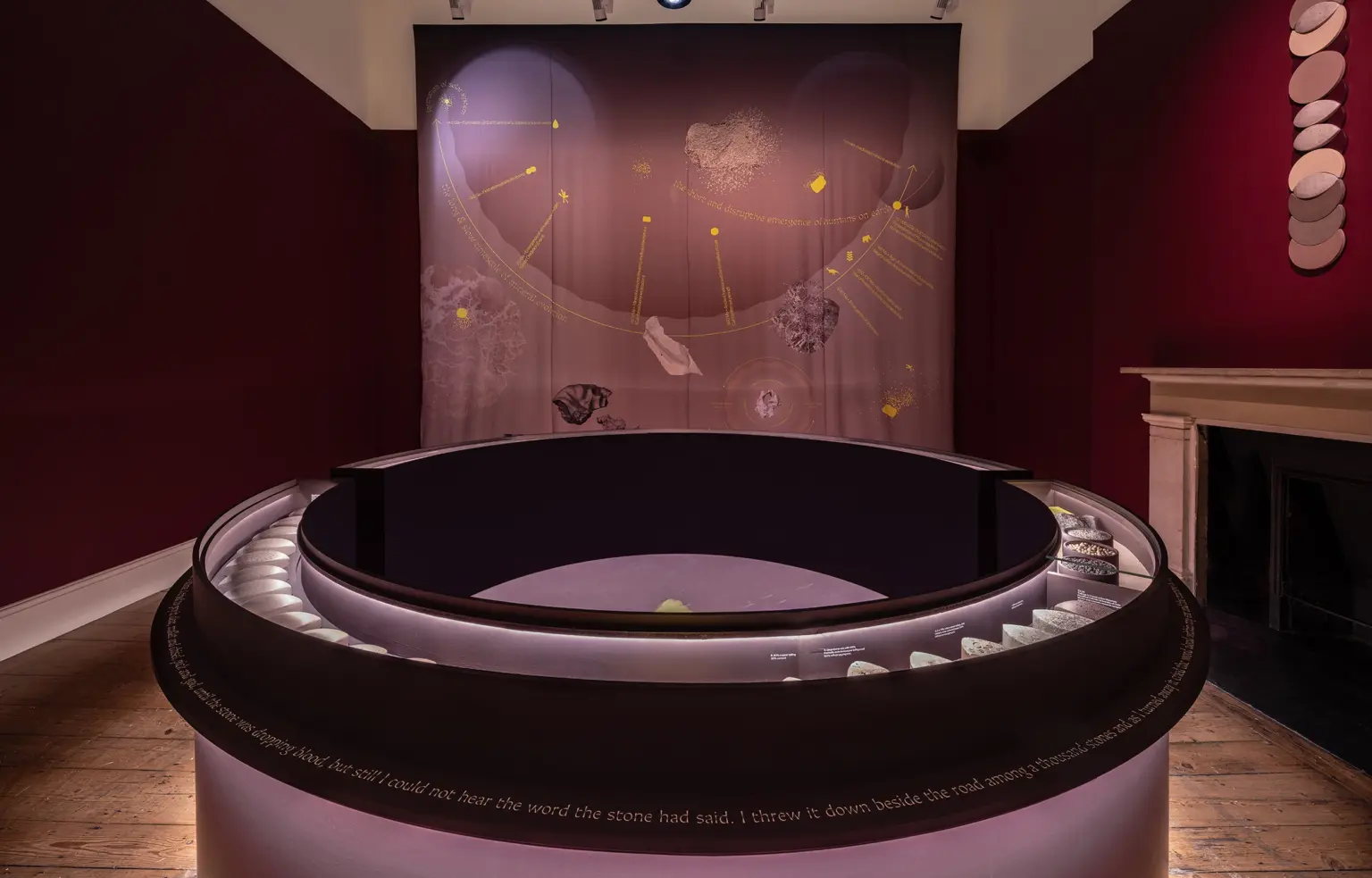
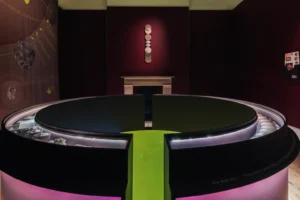
Minerasophia; Underground Cycles is the name of the interdisciplinary proposal that represented Chile at the London Design Biennale, which is holding its fifth edition until 29 June under the title “Surface Reflections”.
The event brought together designers, curators and institutions from around the world to reflect on design as a tool for social, political and environmental change, through installations, exhibitions and collaborative projects representing different countries and cities.
The Chilean proposal invites us to rethink extractivist logic and offers a sensory encounter with the mineral materials that are part of the country's landscape and history.
This participation is one of the annual milestones of the design internationalisation strategy promoted by the Ministry of Cultures, Arts and Heritage in collaboration with ProChile, DIRAC, the Embassy of Chile in the United Kingdom and Fundación Imagen de Chile.
The project is also supported by private institutions such as the Anglo Chilean Society, a UK-based organisation that promotes cultural understanding and friendly relations between Chile and the United Kingdom. The pavilion was developed in collaboration with public-private institutions such as the T2CM (Tailings to Construction Materials) project of the Universidad Católica, which transforms mine tailings into sustainable building materials through innovative physico-chemical processes.
About Minerasophia: Underground Cycles
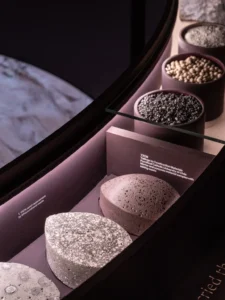
The installation is part of an extensive research project by artist and designer Mále Uribe, who, together with renowned designer Constanza Gaggero, presents sculptures, materials and objects in an audiovisual installation created from processed minerals, tailings and mining waste, as well as semi-precious stones and lithium salts.
These elements, worked together with local artisans and small-scale miners (pirquineros), propose new ways of narrating and redefining the hierarchies of value attributed to each material.
Mále Uribe commented: “We want to show that minerals are not just resources, but living entities with geological and cultural memory. Our goal is to restore a relationship of admiration and respect towards matter and its slow evolutionary rhythm.”
Constanza Gaggero stressed that “today more than ever it is essential to build a new visual narrative around our natural heritage. At a time when we are questioning our relationship with the planet, visual communication can (and must) open the way to a new relationship with our environment.”
Minerasophia explores the tensions between the industrial value and the cultural value of minerals. Through a sensory and contemplative staging, the project proposes a new way of reading the territory: not only as a reserve of raw materials, but as a deep archive of geological time, ancestral knowledge and possible futures.
Art, science, technology and craft converge in this project, encouraging critical reflection on the extractive industry while recognising the local knowledge of working with stones and minerals passed down through generations. The installation is an invitation to imagine other ways of relating to the material environment and to expand the notion of design from an ecological, ethical and cultural perspective.
The designers
Mále Uribe
An architect and artist, Mále Uribe holds an MA from the Royal College of Art in London and has a solid track record in art, spatial design and exhibition design projects developed between London and Santiago.
She has worked with institutions and brands such as the Victoria & Albert Museum, The Design Museum, Prada, Hermès and Nike, among others. She was Art and Research Director at Storey Studio and, in 2019, was selected as artist in residence at the Design Museum in London, where she began her research on the mineral resources of the Chilean desert. Her work has been exhibited at The Design Museum (London), CAFA Art Museum (Beijing), Science Museum (Hong Kong), Royal College of Art (London), Galeria Pada (Lisbon), Palacio Pereira and Galería Gallo (Chile), among others.
She has taught at the Royal College of Art, Camberwell University of the Arts and several Chilean universities, and between 2022 and 2024 led the exhibition design workshop of the Diploma in Museography and Exhibition Spaces at the Pontificia Universidad Católica de Chile. Her work has been published in international media such as the Financial Times, Dezeen and Crafts Magazine.

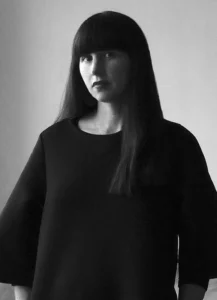
Constanza Gaggero
A designer who studied at the Universidad Diego Portales, with a postgraduate degree in Museum Cultures from the University of London and a diploma in Typography from the Pontificia Universidad Católica de Chile.
She is a member of the prestigious Alliance Graphique Internationale (AGI) and founder of the studio Gaggeroworks, where she is creative director. With almost 20 years of experience in visual identity, she has developed projects in the United Kingdom and Chile with a strong focus on culture.
Her UK clients include Tate, The British Museum, British Council, Royal Academy of Arts, Victoria & Albert Museum, Barbican, National Museums Northern Ireland, Natural History Museum and Arts Council UK. In Chile, she has worked with the Museo Chileno de Arte Precolombino, Museo Histórico Nacional, CCPM, Círculo de Arte Antenna, MIM, Futuro NuMu, CMPC, the Government of Chile and Restorán Liguria, among others. She also works as a consultant for cultural and knowledge institutions and carries out personal research on botany and visual communication.
The London Design Biennale
The London Design Biennale is a global stage for the world's leading contemporary design and for design-driven innovation, creativity and research. Established in 2016, it promotes international collaboration and the global role of design through exhibitions and installations that demonstrate the ambition to create universal solutions to the problems that concern us all.